
Sources for Fullerton Previous Residents
A defensible Fullerton previous residents search begins by assigning each source a time range and a kind of evidence. RecorderWorks can expose the parties to a recorded transaction, while a criss-cross directory can place a listed adult at a street number. Federal census records show a household at a decennial date. Permits and Sanborn sheets explain the structure and street context. The table keeps those layers distinct before a name or address is carried backward.
| Source | Years It Covers | Where Held | What It Shows |
|---|---|---|---|
| RecorderWorks and recorded deeds | Post-1981 online identifier format; earlier years use book/page/instrument references | Orange County Clerk-Recorder / RecorderWorks | Parties, recording dates, legal descriptions, ownership trail after copies are obtained |
| Fullerton city and criss-cross directories | Exact library run not posted; verified Orange County anchors include 1926, 1929, 1931 | Fullerton Public Library Local History Room; NARA listings | Listed occupants, addresses, occupations, spouse or widow notation |
| Federal census | 1900-1950 public under the 72-year rule | NARA, library databases, FamilySearch access points | Household members, relationships, ages, birthplaces, and tenure clues |
| Sanborn fire-insurance maps | 1890, 1894, 1900, 1907, 1911, 1917, 1927; later maps into the 1940s and a 1959 listing | Fullerton Public Library, City Development, digital mapping | Building footprint, material, use, lot and street configuration |
| Historic and current permits | Current archive plus older microfiche reported by the city guide | Fullerton Community and Economic Development | Builder, owner, applicant, contractor, work, and construction dates |
| Newspapers, landmarks, obituary, and probate | Collection-specific dates; 2025 landmark archive is current digital access | Fullerton Library, Orange Superior Court, local newspaper files | Family links, death, heirs, property disposition, and dated local events |
Start with the deed chain for an ownership question, the directory and census layer for an occupant question, and the permit or Sanborn layer for a structure question. A historical resident directory hit is strongest when the address, year, and a second record agree.
Fullerton Past Residents RecorderWorks
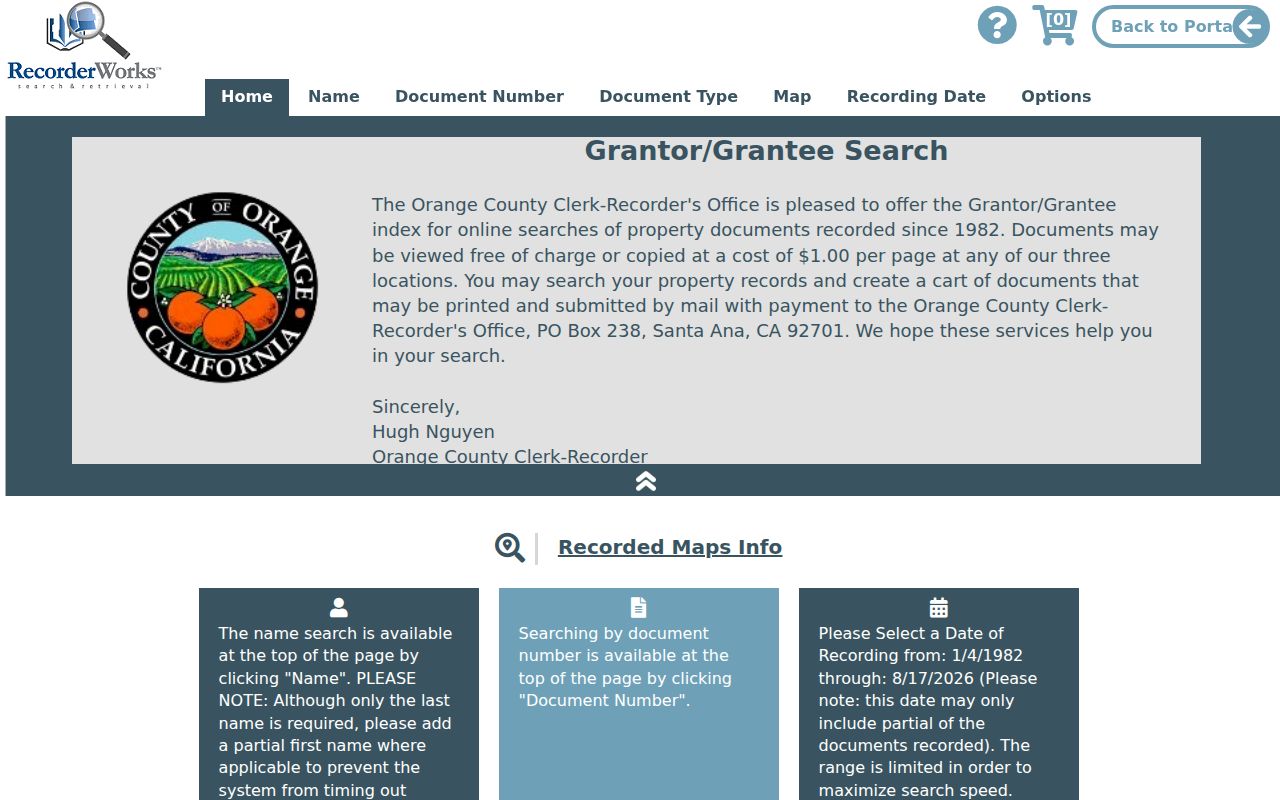
RecorderWorks is the Orange County grantor-grantee index, not a digital book of deed images. Searchers enter a party name, optionally narrow the recording date, filter document title or type, and capture the result identifier. The index can list deeds, deeds of trust, reconveyances, liens, notices, maps, and other recorded titles. It may identify an owner or seller connected to a parcel, but it does not state who occupied the address.
The identifier changes at 1982. From 1982 forward, the useful form is the recording year plus a six-digit instrument number. Before 1982, a copy request depends on book, page, and instrument references. The divide changes how earlier Fullerton previous residents are found, but it does not establish a single definitive first indexed year. Orange County says it will not perform a search by phone, in person, or by mail, so the researcher must run the index and preserve the reference.
The Orange County RecorderWorks search is the direct index path for a Fullerton deed clue.
The RecorderWorks Grantor-Grantee Index shows the search stage that precedes an official-copy request for Fullerton previous residents.
Copies are listed at $1 per page plus $1 certification per document or map. Mail requests go to Orange County Clerk-Recorder, 601 N. Ross Street, Santa Ana, CA 92701, with a self-addressed stamped envelope and payment to County of Orange. That paid step is where a backward trail can be tested against vesting and the parcel description.
Trace Fullerton Previous Residents by Deed
A chain of title is a sequence of recorded ownership transfers for the same legal parcel. To trace Fullerton previous residents through that chain, begin with current parcel evidence, find the acquisition document, and make the seller the next backward search. Keep the legal description beside each result because a similar street number can belong to a different lot or a renamed road.
- Standardize the address in Fullerton GIS and save the APN, situs address, parcel shape, and legal context.
- Compare the Orange County Assessor property-information display or counter record, including mailing address, assessment association, and legal description. The external owner-name web search was not verified, so confirm uncertain results at the Public Service Counter in Orange.
- Search the current owner or grantee in RecorderWorks near the likely acquisition date. Capture the recording year and six-digit instrument number for later records, or book, page, and instrument references for earlier records.
- Obtain the deed copy and compare grantor, grantee, vesting, recording date, and legal description with the APN. The grantor becomes the prior-owner lead.
- Search that prior grantee or owner backward, repeat the legal-description check, and move to older books or other local sources when the online identifier format no longer fits.
- Grantor
- The party transferring an interest in the recorded document.
- Grantee
- The party receiving the interest. A grantee can be a person, trust, company, or other named entity.
- Chain of title
- The linked sequence of transfers that connects a current interest to earlier recorded parties.
- Legal description
- The lot, block, tract, or boundary language that identifies the parcel even when a street number changes.
Ownership is not occupancy. A deed can take the trail through an investor, trust, or family transfer without naming the people who lived in the rooms. That is why the directory and census layer must be kept separate.
Fullerton Past Residents and Address Drift
Fullerton’s townsite began around 1887 and the city incorporated in 1904. Orange County was created from Los Angeles County in 1889. The earliest land and resident trail can therefore cross a jurisdictional change, and a historic Fullerton reference may not match today’s city polygon. A directory, map, or deed from the early period must be read against the period’s county and street grid.
Fullerton Heritage specifically warns house researchers about street-name and house-number changes. Bridge the old and new forms with APN lineage, lot or block language, subdivision maps, neighboring landmarks, and Sanborn sheets. A failed search for a modern number does not prove that the house or family was absent. It may show that the address was renumbered, the road was renamed, or the parcel was described by a tract rather than a street.
Mailing geography adds another trap. Postal Fullerton and the city-limit layer do not always match, and institutional or special ZIP references are not ordinary neighborhoods. Preserve the old wording from the source, then add a modern normalized form in research notes rather than silently replacing it.
Past Fullerton Residents in Directories and Census
Deeds answer who held an interest. Directories and census schedules are the stronger path for past Fullerton residents who occupied an address. The Fullerton Public Library confirms city directories, digital yearbooks, newspapers, building records, maps, and house research. NARA lists Orange County directories that include Fullerton in 1926, 1929, and 1931. The exact library shelf list and publisher run remain a research gap, so Ask an Archivist should confirm the volume before a trip.
Pair a directory year with the nearest federal census year, then treat the result as a bracket rather than a move-in date.
- Normalize the old street name and number with the parcel, map, or Sanborn context before reading the directory.
- Read the street or householder section as well as the alphabetical section, and record the listed name, spouse notation, occupation, address, and any “h” or “r” mark.
- Compare the nearest 1900, 1910, 1920, 1930, 1940, or 1950 census household for names, relationships, ages, birthplaces, and tenure.
- Check the directory year before and after the appearance. A first or last entry can reflect compilation lag, omission, a move, a spelling change, or a missing volume.
- Use permits, Sanborn sheets, deeds, newspapers, and obituaries to test whether a name belongs to the structure, the owner, the occupant, or a nearby business.
The public federal census currently reaches 1950 under the 72-year rule, while 1960 is scheduled for release in 2032. FamilySearch catalog material may require a center or affiliate for locked images. User-contributed trees are leads only. The Fullerton city directory page explains how to read the collection without treating it as a complete resident list.
Sanborn Maps for Fullerton House History
Sanborn fire-insurance maps do not name every previous resident, but they can show whether the address and building existed in the expected form. The Fullerton house-history guide identifies seven original-townsite editions: 1890, 1894, 1900, 1907, 1911, 1917, and 1927. Later maps extend into the 1940s, and the Fullerton Library digital mapping collection includes a 1959 Sanborn item. These editions can bracket a construction date, addition, lot change, street configuration, or change from one use to another.
Read the map beside a directory and deed. A footprint that appears before a directory name may indicate an earlier building or a household omission. A changed footprint can explain why a later address has a new permit trail. The library guide reports that older maps could not be photocopied, so reproduction rules and viewing options should be confirmed with the holding office.
Sanborn evidence is structural, not personal. It supports a house narrative when joined with a permit, a newspaper date, a landmark file, or a listed occupant. It cannot establish that every person in a directory entry lived at the property throughout the map year.
Fullerton Permit Dates and Past Occupants
Fullerton Community and Economic Development provides current permits, historic permit material, planning files, code records, and an archive. The local house-history guidance reports that older permits were kept on microfiche at the second-floor Development Services counter. A permit may supply builder, owner, applicant, contractor, architect, work description, valuation, issue and final dates, inspection milestones, and sometimes room or story measurements. The footing inspection marker “FOO.O.K.” can help place the start of construction.
Permit names are property-actor clues. They may identify a builder or applicant who never lived at the address, and a code case can contain protected complainant information. Request the public address-keyed case log, notice, order, inspection date, and correspondence rather than private reporting-party material. Compare the permit’s APN and legal parcel with the deed and the directory’s street form.
Street renumbering makes this comparison essential. If a directory number does not match the permit, use the original townsite map, Sanborn sheet, subdivision description, and neighboring addresses to build a bridge. The parcel line usually carries more continuity than a street number.
Fullerton Library House-History Archive
The Fullerton Public Library Local History Room is at 353 W. Commonwealth Avenue and lists direct phone (714) 738-6342. Posted hours are Tuesday 11-1 and 3-5, Wednesday 11-1 and 4-7, Thursday 11-1 and 3-5, and Friday 11-1, with Saturday through Monday closed. The Local History Room and Ask an Archivist channel can confirm directory years, address sections, newspapers, yearbooks, maps, and building files.
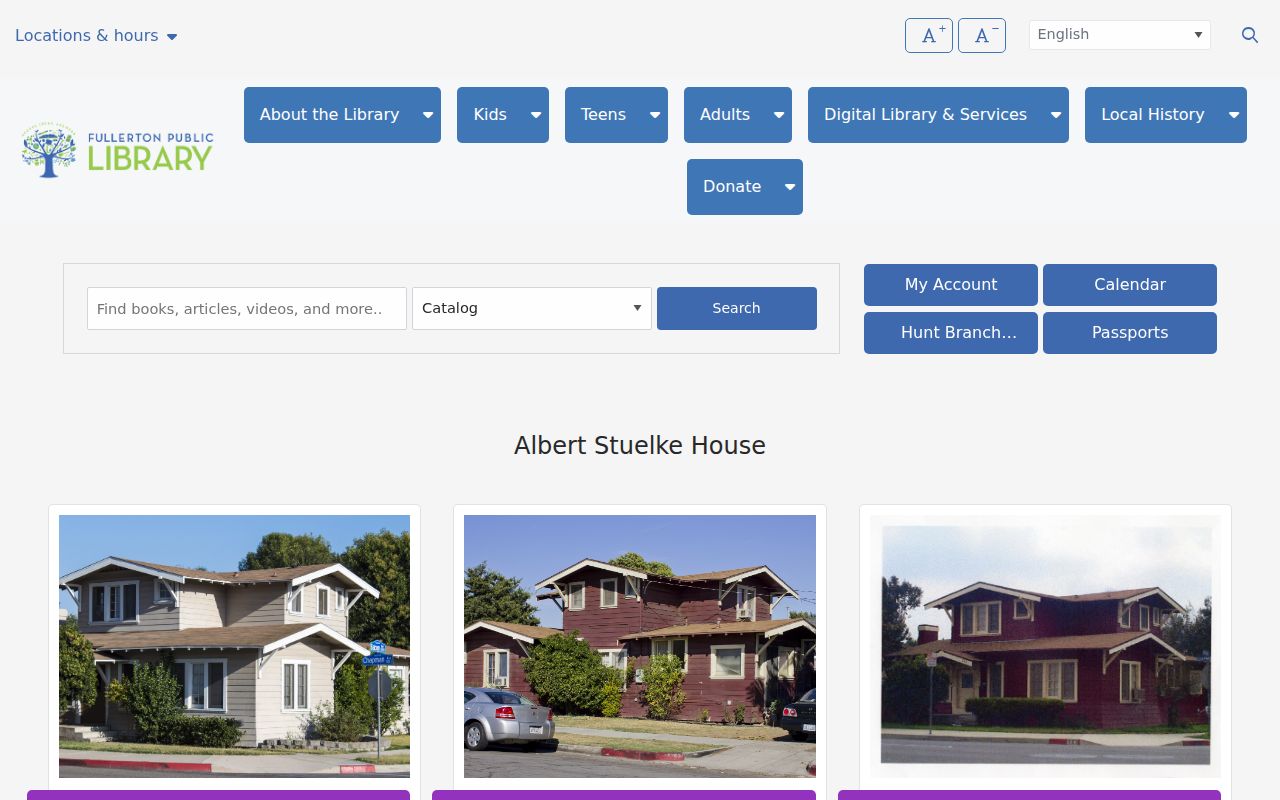
One address-specific landmark file demonstrates the method without making its facts universal. The Albert Stuelke House entry joins a current address, verified 1916 build date, historic and current photographs, a 1978 survey, a Fullerton Heritage profile, a 1927 Sanborn sheet, and newspaper citations from 1927 through 1981.
The Albert Stuelke House record is a useful model for how a Fullerton previous residents file can place property, structure, and dated sources beside one another.
The Fullerton landmark house file shows the type of address dossier that can connect a building to maps, surveys, photos, and newspaper dates.
In 2025 the library launched a 24/7 Digital Archive of Local Historical Landmarks, extending more than fifty years of Local History Room stewardship. Its entries join photographs, documents, narratives, survey material, Sanborn references, and newspaper dates.
The Cal State Fullerton Pollak Library gateway points toward University Archives, special collections, newspapers, and regional holdings that can supplement Fullerton previous residents research.

Pollak Library and University Archives preserve campus publications, photographs, oral histories, yearbooks, student newspapers, and regional collections. The Online Archive of California can identify collection descriptions before a box request, while modern student records remain subject to privacy rules.
Fullerton Previous Residents: Obituary Endpoints
Obituaries and probate can close a previous-resident trail after an occupant leaves the address or dies. Fullerton Library landmark pages cite local papers such as Fullerton News Tribune and Fullerton News by exact date. Search the date with the surname or address, inspect adjacent issues, and compare the family names with a vital or court record. An obituary is a valuable lead, but user-submitted details and newspaper errors still need corroboration.
Orange Superior Court probate access can supply a decedent name, case number, heir notices, and property-disposition clues. Remote access can show an index or register while probate documents remain unavailable to the general public online. Use the Central Justice Center Records Unit in Santa Ana for the public file path, guided by case number and case type. A probate trail can identify heirs without claiming that each heir lived at the historic address.
For a family or estate question, combine the obituary, probate index, deed chain, and unclaimed-property search. The State Controller’s search uses name, address, city, property number, a less-specific option, and CAPTCHA, with the first 500 matches displayed. Search and claim are free, but an unclaimed-property address is a last-known clue rather than a current residence.
Owner History Versus Fullerton Previous Residents
Owner history and occupant history overlap only sometimes. A deed names a grantor or grantee. An assessment record relates an owner or tax mailing address to a parcel. A directory lists a person who appeared in a publication year. A census records a household at an enumeration date. A permit identifies a property actor. Those are useful layers, but they are not interchangeable.
| Question | Strongest starting source | Careful wording |
|---|---|---|
| Who held title? | Recorded deed and legal description | “Recorded grantee” or “owner in the deed trail” |
| Who was listed at the address? | Criss-cross or city directory | “Listed occupant for that publication year” |
| Who was in the household? | Nearest public federal census | “Enumerated household at the census date” |
| When did the structure change? | Permit, Sanborn, landmark, or newspaper | “Construction or alteration evidence” |
| Who inherited or received property? | Probate plus deed disposition | “Public heir or transfer clue” |
Lawful house history. Fullerton previous residents research is appropriate for genealogy, preservation, family history, and an estate or property narrative. Do not use a historic or current record to stalk, track, threaten, dox, or harass a living person. Stop when a confidentiality program, sealed record, or safety concern applies.
A careful conclusion says what the records support and what they do not. “The 1931 directory lists an adult at the number” is stronger than “everyone who lived there in 1931.” “The deed records a transfer of the parcel” is stronger than “the grantee lived there.” That precision is what makes a Fullerton previous residents trail useful across time.